
Folk & Plucked
Banjo
The banjo is built around a circular rim covered with a stretched skin or synthetic head, which gives it a bright, percussive tone unlike any other instrument in this library. Five-string banjos, often played open-back in old-time styles or with a resonator in bluegrass, are the most common variant in the United States today, while four-string tenor banjos have their own distinct history in early jazz and Irish traditional music.
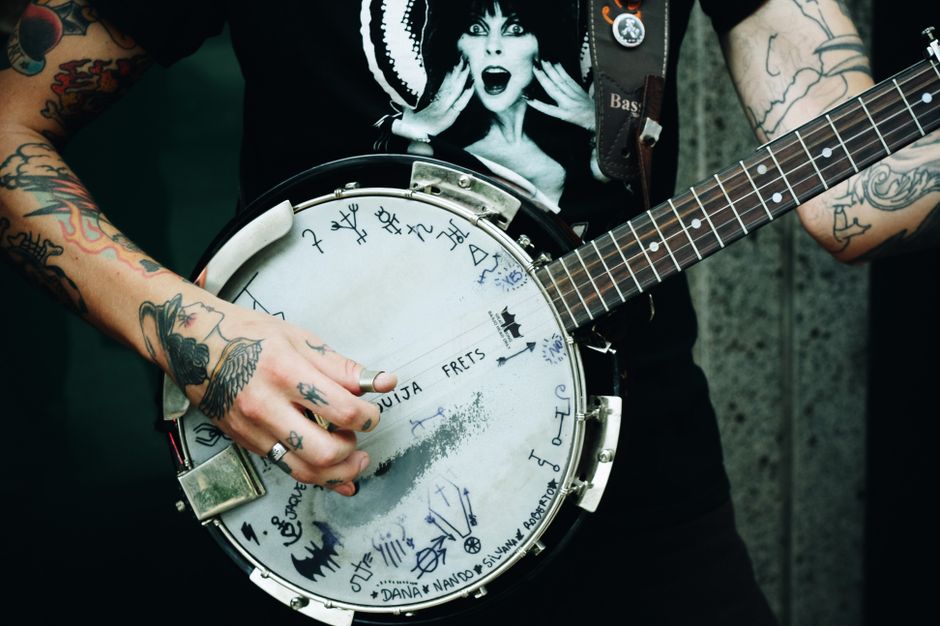
Photo by Matheus Ferrero via Pexels
| Family | Folk & Plucked |
|---|---|
| Region / context | West Africa, developed in the Americas |
| Playing method | Fingerpicked (clawhammer or three-finger/Scruggs style) or strummed, depending on tradition |
| Number of strings | 5 strings (old-time/bluegrass) or 4 strings (tenor/plectrum banjo) |
| Common tuning | 5-string open G (g-D-G-B-D) is widely used, among several other common alternate tunings |
| String material | Steel, sometimes with a nylon or synthetic fifth string |
| Construction | Circular rim with a stretched head; open-back designs are common in old-time music, while resonator backs (common in bluegrass) project sound forward and increase volume |
| Size range | Neck length comparable to a guitar, with a round body roughly 28-30 cm in diameter |
| Portability | Portable — Lightweight but the round rim makes it slightly bulkier to case and carry than a guitar. |
| Acoustic volume | Loud — Bright and percussive, able to cut through a string band or bluegrass ensemble. |
| Musical contexts | Foundational to American old-time and bluegrass music, with four-string variants important to early jazz and Irish traditional music. |
| Beginner learning curve | Moderate-Demanding — Three-finger bluegrass-style picking has a notable learning curve, though clawhammer is often considered a more approachable entry point into the instrument. |
| Maintenance | Head tension and tuning require periodic adjustment, and the head itself may eventually need replacement. |
| Amplification | Acoustic by design; pickups exist for stage use but are less standard than on guitar. |
| Practice environments | Its bright, percussive volume makes it less ideal for late-night practice in shared housing. |
Origin and Background
The banjo's ancestry traces to West African gourd-and-skin lute instruments, which enslaved Africans and their descendants recreated and developed in the Americas; the instrument was later commercialized and widely adopted, including through 19th-century minstrel music, a history that is now acknowledged as part of its complex legacy.
Sources
- Smithsonian Institution, National Museum of American History
- Grove Music Online
Content last checked against our reference sources on October 14, 2026. See our sources and methodology page for how we research instrument profiles.