
Folk & Plucked
Dulcimer (Appalachian)
The Appalachian dulcimer is played flat on the lap, with a long, narrow soundbox and a diatonic fretboard that omits some of the notes found on a fully chromatic instrument. This limited fretting, combined with the use of a sliding noter along the melody string in traditional styles, makes picking out a simple tune unusually approachable for newcomers.
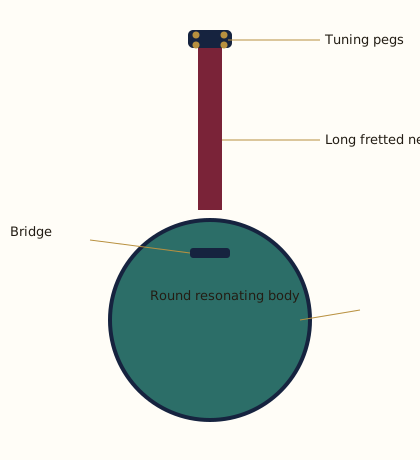
| Family | Folk & Plucked |
|---|---|
| Region / context | Appalachian region, United States |
| Playing method | Plucked or strummed while held flat on the lap, often with a noter sliding along the melody string |
| Number of strings | 3 or 4 strings (4-string models typically double the melody course) |
| Common tuning | Common modal tunings include D-A-D and D-A-A, among others, chosen to suit traditional modal melodies |
| String material | Steel |
| Construction | Elongated hourglass or teardrop-shaped soundbox with the fretboard running along the top surface |
| Size range | Compact, lap-sized instrument, generally under a meter in length |
| Portability | Very portable — Light and easy to carry, similar in convenience to a ukulele. |
| Acoustic volume | Quiet — Intimate and soft, suited to close listening rather than ensemble projection. |
| Musical contexts | Closely associated with Appalachian folk and old-time music traditions. |
| Beginner learning curve | Approachable — The diatonic fretboard removes some of the note choices a chromatic instrument offers, which many newcomers find makes simple melodies easier to pick out right away. |
| Maintenance | Light tension and few strings keep maintenance simple; occasional restringing and tuning are the main tasks. |
| Amplification | Acoustic by design; pickups exist but are uncommon. |
| Practice environments | Quiet enough for virtually any home setting. |
Origin and Background
The Appalachian (mountain) dulcimer developed in the 19th-century Appalachian region of the United States, likely influenced by earlier European fretted zithers such as the German scheitholt brought by settlers; it is distinct from the unrelated hammered dulcimer, a trapezoidal struck-string instrument.
Sources
- Smithsonian Institution, National Museum of American History
- Grove Music Online
Content last checked against our reference sources on October 14, 2026. See our sources and methodology page for how we research instrument profiles.