
Folk & Plucked
Harp
The harp is built so its strings run roughly perpendicular to the soundboard, each one plucked individually by the fingers rather than fretted or stopped. The large orchestral pedal harp uses seven foot pedals to raise or lower the pitch of each note name, while smaller lever harps use hand-operated levers for a similar, if less flexible, effect.
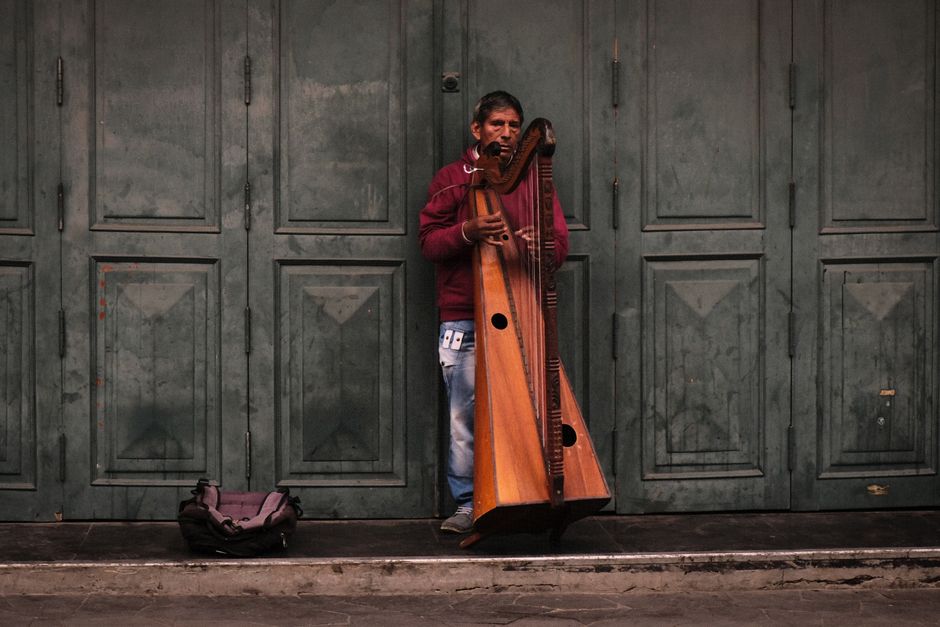
Photo by Johanna M Jaramillo via Pexels
| Family | Folk & Plucked |
|---|---|
| Region / context | Ancient origins across multiple cultures; modern pedal harp developed in Europe |
| Playing method | Plucked with the fingers, no pick used |
| Number of strings | Pedal harps typically have 47 strings; lever and folk harps vary widely, often from about 22 to 40 strings |
| Common tuning | Base tuning follows a diatonic (C major) scale; pedals or levers raise individual strings by semitones to reach other keys |
| String material | Gut, nylon, or steel, often mixed across the instrument's range |
| Construction | Large triangular frame with a soundboard, neck, and pillar; pedal harps stand on a pedestal base, while folk harps are smaller and sometimes played on the lap |
| Size range | Pedal harps stand around 1.8 m tall; folk and lever harps range from compact tabletop models to floor-standing instruments |
| Portability | Low — The pedal harp is one of the least portable instruments in this library; smaller lever and folk harps are considerably easier to transport. |
| Acoustic volume | Moderate — Resonant but not loud, with limited sustain control once a string has been plucked. |
| Musical contexts | Used in orchestral and chamber music, Celtic and other folk traditions, and contemporary and film scoring contexts. |
| Beginner learning curve | Varies widely — Small lever or folk harps are often considered approachable starting instruments, while the pedal harp's foot coordination makes it considerably more demanding. |
| Maintenance | Frequent tuning across many strings, periodic string replacement, and careful handling of the pedal or lever mechanism. |
| Amplification | Acoustic by design; pickups are available for some folk harps used in amplified settings. |
| Practice environments | Its size (for pedal harps) and the room needed to play comfortably make home practice easier with a smaller lever harp. |
Origin and Background
Harps appear independently in many of the world's oldest musical traditions, including ancient Egypt and Mesopotamia; the modern orchestral pedal harp took shape in Europe, with Sébastien Érard's double-action pedal mechanism of the early 19th century establishing its standard design.
Sources
- The Metropolitan Museum of Art, Department of Musical Instruments
- Grove Music Online
Content last checked against our reference sources on October 14, 2026. See our sources and methodology page for how we research instrument profiles.