
Bowed Strings
Electric Violin
The electric violin is bowed just like an acoustic violin, but its solid or minimal body produces very little sound on its own, relying on a built-in piezo or magnetic pickup system and external amplification. Body shapes vary widely by maker, often skeletal or cutaway in design, since the instrument no longer needs a resonant acoustic chamber.
Bowed
United States
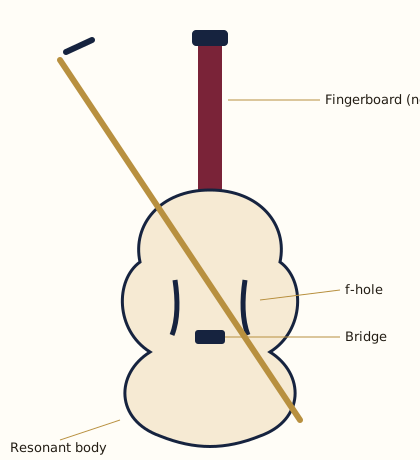
| Family | Bowed Strings |
|---|---|
| Region / context | United States |
| Playing method | Bowed, like an acoustic violin, with amplification required to be heard clearly |
| Number of strings | 4 strings (5-string extended-range models adding a lower string also exist) |
| Common tuning | Standard: G3-D4-A4-E5, the same as an acoustic violin (5-string models add a low C) |
| String material | Steel or synthetic-core strings with metal winding, similar to acoustic violin strings |
| Construction | Solid or minimal-body design, often skeletal or cutaway in shape, with a built-in pickup system |
| Size range | Similar playing dimensions to an acoustic violin, though body shape varies widely by maker |
| Portability | Portable — Often more travel-friendly than an acoustic violin since the solid body is less fragile, though it requires carrying amplification gear. |
| Acoustic volume | Silent unamplified — Very quiet without amplification, by design. |
| Musical contexts | Used in contemporary classical crossover, rock, jazz fusion, and electronic or looping-based performance. |
| Beginner learning curve | Demanding — Shares the same bowing and fingering fundamentals as the acoustic violin, with an added layer of amplification and effects technique. |
| Maintenance | Similar string and bow care to an acoustic violin, plus upkeep of the pickup system and any onboard electronics. |
| Amplification | Requires amplification; this is a defining feature of the instrument rather than an option. |
| Practice environments | Can be practiced quietly through headphones via an amp or interface, unlike an acoustic violin. |
Origin and Background
Experiments with electrically amplified violins date to the 1930s and 1940s in the United States, with solid-body electric violins becoming more widely available and refined from the later 20th century onward.
Sources
- Grove Music Online
- Smithsonian Institution, National Museum of American History
Content last checked against our reference sources on October 14, 2026. See our sources and methodology page for how we research instrument profiles.