
Bowed Strings
Violin
The violin is the smallest and highest-pitched member of the orchestral bowed string family. Its arched, carved body and f-shaped soundholes give it a bright, projecting tone, and its lack of frets means pitch is located entirely by ear and muscle memory. It plays a leading role in Western classical music and in many folk and fiddle traditions worldwide.
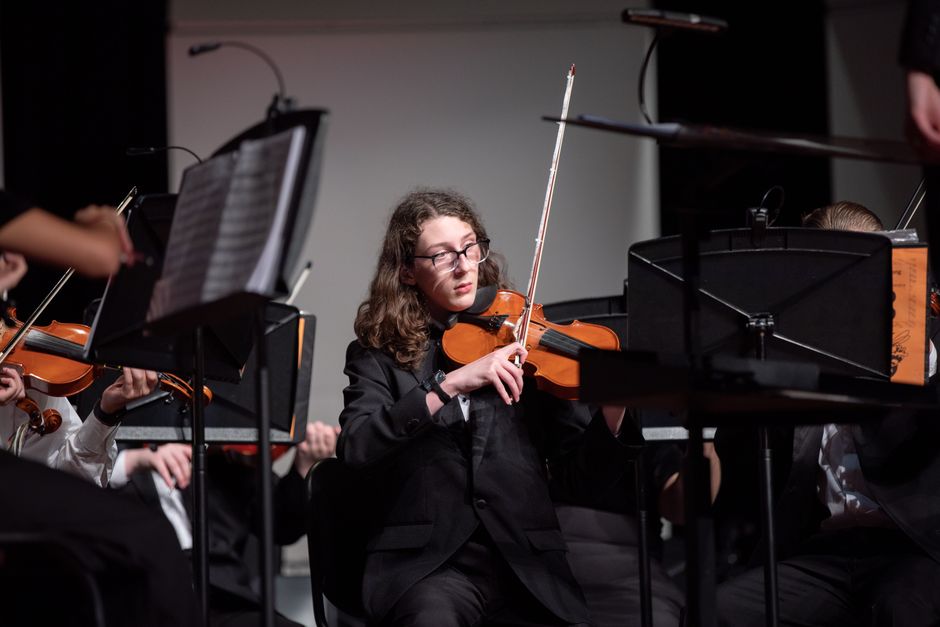
Photo by Roxanne Minnish via Pexels
| Family | Bowed Strings |
|---|---|
| Region / context | Northern Italy |
| Playing method | Bowed, held under the chin; also played pizzicato (plucked) at times |
| Number of strings | 4 strings |
| Common tuning | G3-D4-A4-E5 (low to high), tuned in perfect fifths |
| String material | Historically gut; modern strings are typically steel or synthetic-core with metal winding |
| Construction | Carved arched top and back, f-holes, hourglass-shaped body; the smallest body among the standard orchestral bowed strings |
| Size range | Full size (4/4) body length around 35.5 cm; fractional sizes from 1/16 to 3/4 are made for younger players |
| Portability | Very portable — The lightest and smallest of the orchestral string instruments, easily carried in a shoulder case. |
| Acoustic volume | Moderate — Bright and penetrating for its size, allowing it to project over an ensemble despite its small body. |
| Musical contexts | Central to orchestral and chamber music, and foundational to many fiddle traditions, including bluegrass and various folk styles worldwide. |
| Beginner learning curve | Demanding — The absence of frets and the independent demands of bow arm and left-hand pitch make the first months considerably more demanding than fretted instruments for most learners. |
| Maintenance | Regular bow rehairing, string replacement, bridge and pegbox checks, and humidity control for the wooden body. |
| Amplification | Acoustic by design; electric and electro-acoustic versions exist for amplified settings. |
| Practice environments | Its bright tone and the sound of early bowing practice are noticeable in shared housing; a practice mute can help. |
Origin and Background
The violin took its standardized form in 16th-century Cremona, Italy, in the workshops of makers such as the Amati family, and was later refined by Stradivari and Guarneri in the following two centuries.
Sources
- The Metropolitan Museum of Art, Department of Musical Instruments
- Grove Music Online
Content last checked against our reference sources on October 14, 2026. See our sources and methodology page for how we research instrument profiles.