
Bowed Strings
Viola
The viola sits between the violin and cello in both pitch and size, providing the alto voice in string quartets, chamber ensembles, and orchestras. Because violas are built in a range of body lengths rather than one fixed standard size, players often try several before settling on one that suits their reach and the tone they prefer.
Bowed
Northern Italy
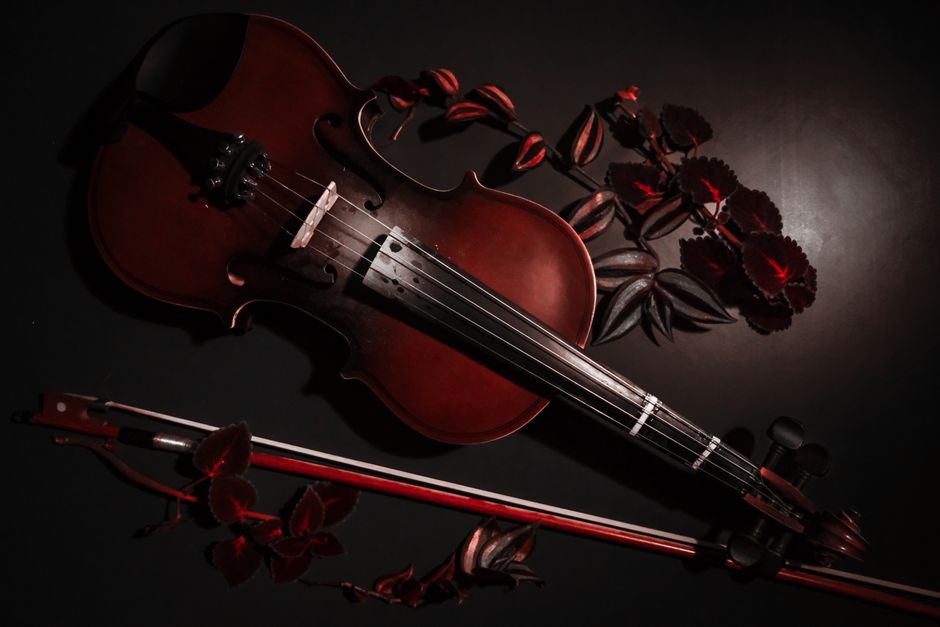
Photo by Enes Beydilli via Pexels
| Family | Bowed Strings |
|---|---|
| Region / context | Northern Italy |
| Playing method | Bowed, held under the chin like a violin, though its larger size changes the left-hand stretch |
| Number of strings | 4 strings |
| Common tuning | C3-G3-D4-A4 (low to high), a perfect fifth below the violin |
| String material | Steel or synthetic-core strings with metal winding, similar in construction to violin strings but heavier gauge |
| Construction | Similar shape to a violin but larger, with body lengths varying by maker rather than a single fixed standard |
| Size range | Body length commonly between 38 and 43 cm, depending on the instrument |
| Portability | Very portable — Slightly larger and heavier than a violin but still easily carried in a shoulder case. |
| Acoustic volume | Moderate — Darker and mellower than a violin, generally with somewhat less high-end projection. |
| Musical contexts | Primarily found in orchestral and chamber music, including the alto voice of the standard string quartet. |
| Beginner learning curve | Demanding — Shares the violin's fretless, independent bow-and-left-hand demands, with an added stretch for the larger body; many players move to viola after starting on violin. |
| Maintenance | Similar upkeep to a violin: bow rehairing, string changes, and humidity control. |
| Amplification | Acoustic by design; electric versions exist but are less common than electric violins. |
| Practice environments | Comparable to the violin; early practice is audible in shared spaces. |
Origin and Background
The viola developed alongside the violin in 16th-century Italy as the alto voice of the new bowed string family, though its exact body proportions were never as fully standardized as the violin's.
Sources
- Grove Music Online
- The Metropolitan Museum of Art, Department of Musical Instruments
Content last checked against our reference sources on October 14, 2026. See our sources and methodology page for how we research instrument profiles.