
Guitars
Lap Steel Guitar
The lap steel guitar is played horizontally, either across the lap or on a stand, with a metal or glass bar sliding along the strings instead of conventional fretting. Many models use open or slide-friendly tunings and a raised string action, and the instrument's smooth, singing slides became a defining sound of early country and Hawaiian music.
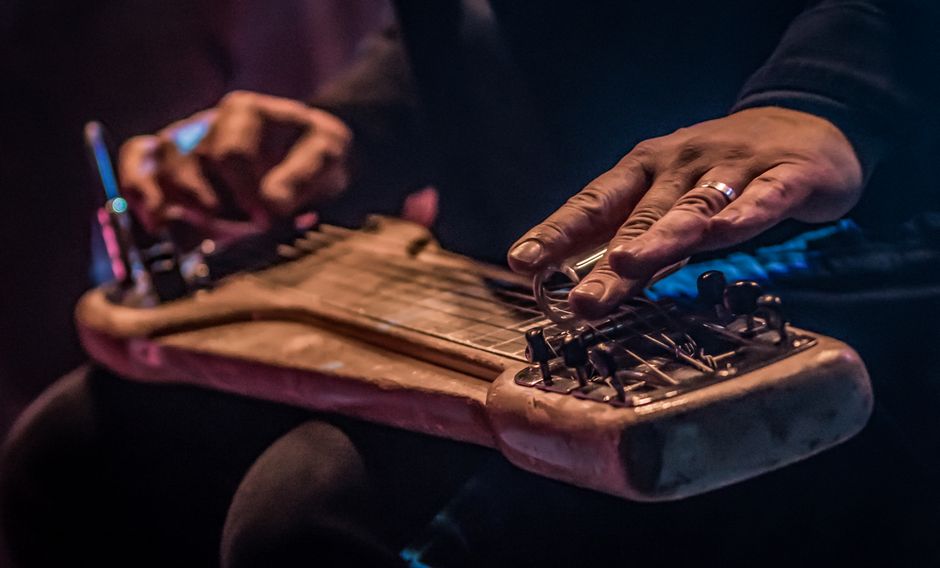
Photo by Will Carter via Pexels
| Family | Guitars |
|---|---|
| Region / context | Hawaii, commercialized in the United States |
| Playing method | Played horizontally with a sliding steel bar rather than fretting with the fingers |
| Number of strings | Commonly 6 strings (7- and 8-string, and multi-neck configurations also exist) |
| Common tuning | Many open and slide-friendly tunings are used, such as open A, open E, and C6, rather than one single standard |
| String material | Steel |
| Construction | Solid or resonator body, often with no functional frets since the slide technique does not require them |
| Size range | Comparable to a small solid-body guitar |
| Portability | Portable — Single-neck models are easy to transport; multi-neck versions are bulkier. |
| Acoustic volume | Quiet unamplified — Electric models are quiet without an amplifier; resonator-style lap steels are moderately louder on their own. |
| Musical contexts | A defining sound in early country and Hawaiian music, with continued use in blues and Americana. |
| Beginner learning curve | Moderate — Slide technique and open tunings are a different skill set from standard fretting, though getting started with guidance is approachable. |
| Maintenance | String changes and periodic action/tuning adjustments for the chosen open tuning. |
| Amplification | Electric models require an amplifier; resonator-style models are acoustic by design. |
| Practice environments | Electric versions can be practiced quietly through headphones via an amp or interface. |
Origin and Background
The technique of sliding a steel bar along guitar strings developed in Hawaii in the late 19th and early 20th centuries, popularly associated with musician Joseph Kekuku, and was amplified and commercialized on the US mainland from the 1920s and 1930s onward.
Sources
- Smithsonian Institution, National Museum of American History
- Grove Music Online
Content last checked against our reference sources on October 14, 2026. See our sources and methodology page for how we research instrument profiles.