
Guitars
Resonator Guitar
The resonator guitar uses one or more metal cones mounted inside its body to project sound more loudly than a standard flat-top acoustic guitar, which was the original motivation behind its design. It can be played in standard fretted style or held horizontally and played with a slide, a technique especially associated with blues and bluegrass dobro playing.
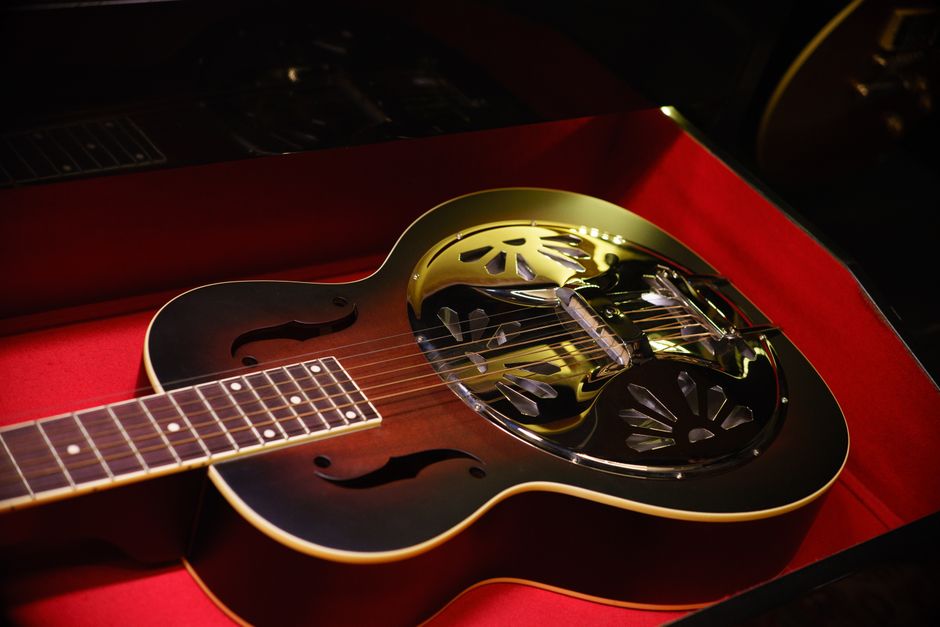
Photo by Fredo Jaimes via Pexels
| Family | Guitars |
|---|---|
| Region / context | United States |
| Playing method | Played in standard fretted style, or horizontally with a slide (especially in blues and bluegrass dobro styles) |
| Number of strings | Commonly 6 strings (tricone and single-cone models offer different tonal character) |
| Common tuning | Standard guitar tuning for fretted playing; open tunings are common for slide playing |
| String material | Steel |
| Construction | Metal resonator cone or cones mounted inside a wood or metal body |
| Size range | Similar overall size to a standard acoustic guitar |
| Portability | Portable — Comparable to a standard acoustic guitar for travel, though somewhat heavier due to the metal cone. |
| Acoustic volume | Loud — Louder and brighter than a standard flat-top acoustic guitar, which was the design's original purpose. |
| Musical contexts | Common in blues, bluegrass, country, and Americana, including dedicated dobro slide styles. |
| Beginner learning curve | Moderate — Similar entry difficulty to a standard acoustic guitar, with slide technique available as an additional skill to develop. |
| Maintenance | Routine string changes and periodic care of the resonator cone and its mounting. |
| Amplification | Acoustic by design; pickups are available for stage use. |
| Practice environments | Its louder volume makes it less ideal for late-night practice in shared housing. |
Origin and Background
Resonator guitars were patented in the late 1920s by the Dopyera brothers and the National String Instrument Corporation, developed to give acoustic guitars more volume before widespread electric amplification was available.
Sources
- Smithsonian Institution, National Museum of American History
- Grove Music Online
Content last checked against our reference sources on October 14, 2026. See our sources and methodology page for how we research instrument profiles.