
World Traditions
Oud
The oud is a fretless, short-necked instrument with a deep, rounded bowl-back body, plucked with a flexible plectrum called a risha. Because it has no frets, pitch and ornamentation are shaped entirely by the player's ear and finger placement, and its tuning and playing conventions vary across the Arabic, Turkish, and Persian traditions in which it is central.
Plucked
Middle East and North Africa
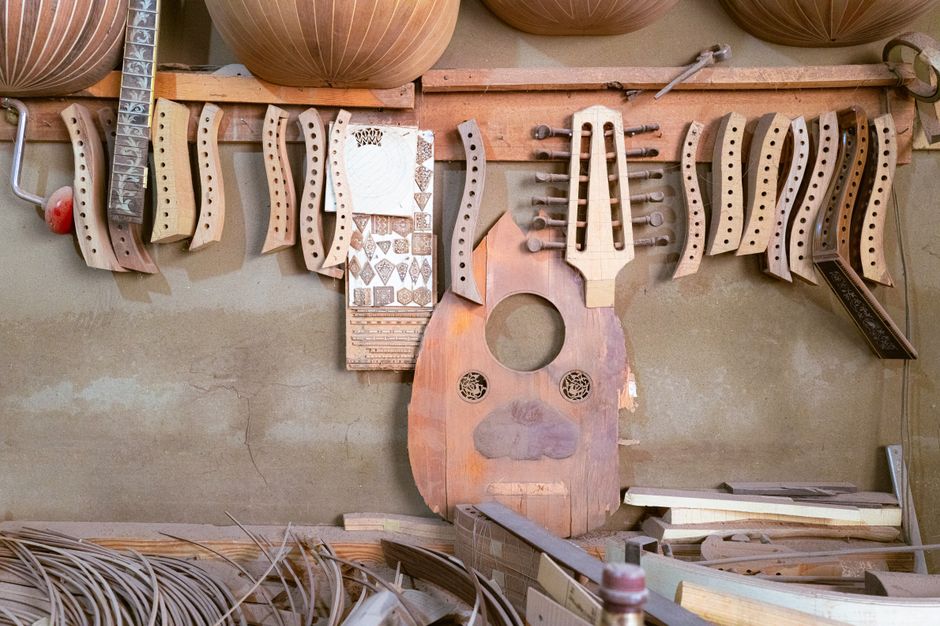
Photo by Anthony Rahayel via Pexels
| Family | World Traditions |
|---|---|
| Region / context | Middle East and North Africa |
| Playing method | Plucked with a flexible plectrum (risha); fretless neck |
| Number of strings | Typically 11 or 12 strings in 5 to 6 courses, mostly paired, sometimes with one single bass string |
| Common tuning | Varies by regional tradition; there is no single universal standard, though tunings are often built from a mix of fourths |
| String material | Nylon or synthetic strings, often with wound bass courses |
| Construction | Deep, rounded bowl-back body, short fretless neck, and a pegbox bent slightly back from the neck |
| Size range | Comparable in overall length to a lute |
| Portability | Moderate — The bowl-back body needs careful handling and a well-fitted case for travel. |
| Acoustic volume | Moderate — Warm and resonant, well suited to intimate ensemble and solo settings. |
| Musical contexts | Central to Arabic classical and folk music, and to Turkish and Persian classical traditions, each with its own conventions. |
| Beginner learning curve | Demanding — The fretless neck demands careful ear training, which tends to be more demanding for players coming from fretted Western instruments. |
| Maintenance | Frequent tuning given the number of courses, and humidity care for the bowl-back body. |
| Amplification | Acoustic by design; pickups are used in some contemporary and amplified performance contexts. |
| Practice environments | Its moderate volume suits most home practice settings. |
Origin and Background
The oud has roots extending back well over a thousand years within Arabic, Persian, and Turkish musical traditions, and it is the direct ancestor of the European lute.
Sources
- Grove Music Online
- The Metropolitan Museum of Art, Department of Musical Instruments
Content last checked against our reference sources on October 14, 2026. See our sources and methodology page for how we research instrument profiles.