
World Traditions
Erhu
The erhu is a two-string bowed instrument held vertically on the lap, with the bow hair passing between its two strings rather than over them. It has no fingerboard, so the strings are pressed directly against the player's fingers in the air, a design that contributes to its famously expressive, voice-like tone.
Bowed
China
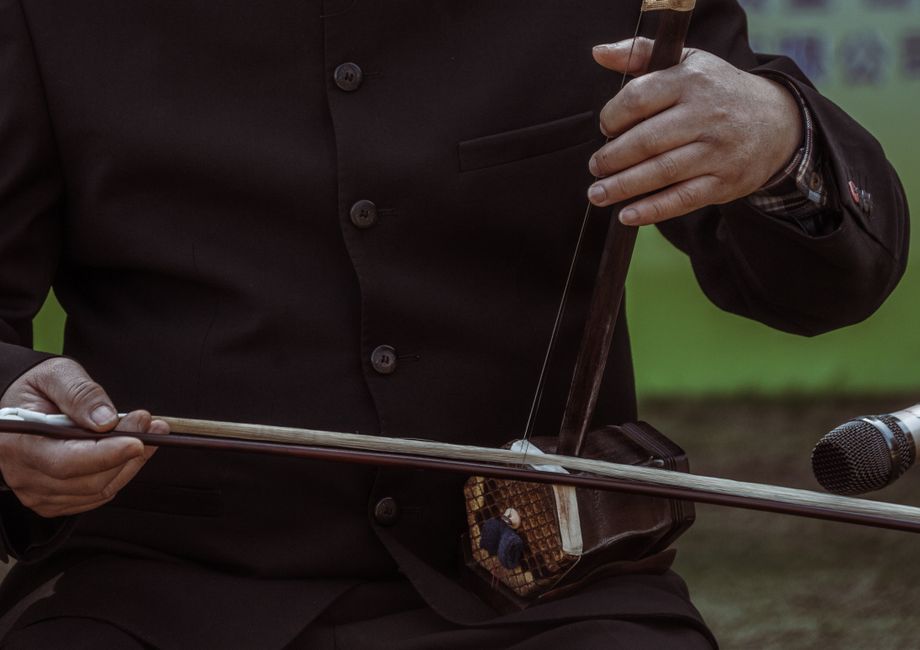
| Family | World Traditions |
|---|---|
| Region / context | China |
| Playing method | Bowed, held vertically on the lap; the bow hair passes between the two strings |
| Number of strings | 2 strings |
| Common tuning | Commonly D4 and A4 (a perfect fifth apart), though this varies somewhat by regional practice |
| String material | Steel, sometimes with silk used historically |
| Construction | Small hexagonal or octagonal resonator, traditionally covered with snakeskin or a synthetic equivalent, with a long thin neck and no fingerboard |
| Size range | Compact relative to Western bowed string instruments |
| Portability | Portable — Light and relatively easy to carry, though the resonator head needs protection from humidity changes. |
| Acoustic volume | Moderate — Known for an expressive, voice-like tone rather than sheer volume. |
| Musical contexts | Used in Chinese traditional and classical music, modern Chinese orchestral works, and crossover or film-scoring contexts. |
| Beginner learning curve | Demanding — The lack of a fingerboard and the bow-between-strings technique differ substantially from Western bowed instruments, making the early stages considerably demanding. |
| Maintenance | Careful handling of the skin-covered resonator, periodic restringing, and bow rehairing. |
| Amplification | Acoustic by design; microphones are used for amplified performance. |
| Practice environments | Its moderate volume suits most home practice settings. |
Origin and Background
The erhu belongs to the huqin family of bowed instruments, with ancestry tracing back over a thousand years and deeper roots connected to Central Asian bowed instruments.
Sources
- Grove Music Online
- The Metropolitan Museum of Art, Department of Musical Instruments
Content last checked against our reference sources on October 14, 2026. See our sources and methodology page for how we research instrument profiles.